

The rise of alternative accommodation concepts in the last years led to a profound change in the hospitality industry. Serviced apartments have arrived in the middle of society – but who offers this product and how do the providers differ?
SERVICED APARTMENTS AS AN HOTEL ALTERNATIVE
- The product „home away from home“ lead to change in the hospitality industry
- New customer requirements gave rise to a new type of service offering in the accommodation market
- Serviced apartment providers differ primarily in the services they offer and the length of stay
MUNICH. Up to now, the real estate industry in general and the hotel industry in particular have been regarded as not very innovative. Even today the two industries are not exactly equated with innovation – but that is changing.
Start-ups in the hospitality industry exert a great deal of pressure on the existing hotel offer, thereby shaping a lasting expansion of the provided range of services. Since Airbnb was founded in 2008, „staying with strangers“ has found its way into the middle of our society.
One of the success factors of the Silicon Valley company is the sense of a more personal experience, often referred to as a „home away from home“ in the industry. According to a study by Morgan Stanley, 42% of Airbnb customers have replaced their former hotel stay with the digital provider. As a result, travellers around the world have found the format of the „fully furnished apartment“ very appealing.
Increased competition for hotels
Established hotel operators are responding to this development by an extension of their business model and service offerings. Instead of „traditional“ hotel properties, they are increasingly investing in real estate that is in direct competition with Airbnb. Of course, Airbnb is not exempt from mistakes – increasing regulatory restrictions, as well as a lack of standards in terms of equipment and cleaning, promote the growth of professional providers of „Serviced Apartments“.
Serviced Apartments are furnished apartments that are specially designed to meet the needs of business & private travellers by offering a temporary home. The accommodations are as easy and flexible to book as a hotel room but have all the amenities that hotels lack. And the concept is well received – in Germany alone, there are already more than 35,500 apartments available for guests – and the trend is rising rapidly!
However, when selecting a provider of serviced apartments, guests are still somewhat left alone. There is no generally apllicable assessment system, like hotel star categories yet.
Classifying serviced apartment providers
The classification of providers based on the typical length of stay and range of services provided, allows an initial subdivision of the market. As a hybrid form, serviced apartments are in both, the „shortstay“ and „longstay“ segments.
The shortstay segment is focussed on offering daily stays, just like hotels. This is accompanied by a traditional service level, such as a reception, restaurant, and fitness offering. Companies such as Adina, Ruby Hotels, Derag Hotel & Living and Marriot Executive Apartments were able to establish themselves on the German market with a hotel-like concept.
The longstay segment focuses on stays of 3-6 months. Due to megatrends such as the increasing mobility in the working world, as well as project-related stays, young professionals, and business travellers are looking for an alternative to the classic hotel. The focus of providers such as Smartments or Ilive is therefore clearly on providing a temporary home. The hotel service is usually replaced here by fully furnished apartments.
There are also companies that are able to operate in both segments. An example for this is the Limehome GmbH, which already offers short to long-term overnight accommodation at more than 45 locations in Germany, Austria and Spain. By a careful location selection as well as co-operation with external service providers, limehome guests can access a flexible service offering. Such providers are characterized by a strong degree of digitalization, to revolutionize the traditional hotel industry.
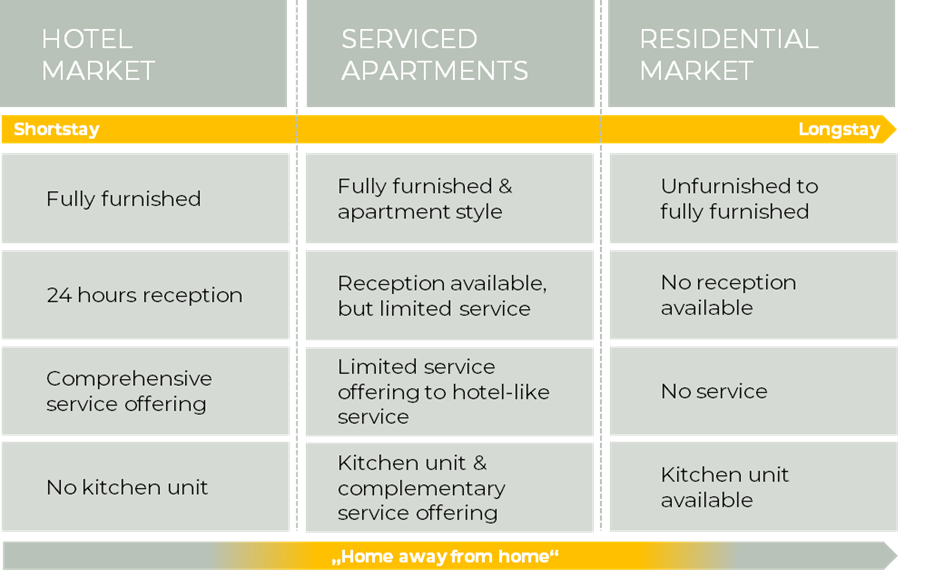
The shift in customer demand and arising pressure from digitalization has shown that hotels need to adapt their product to remain competitive. Since digital providers such as Airbnb are not exempt from mistakes either, professional providers of serviced apartments have experienced worldwide growth.